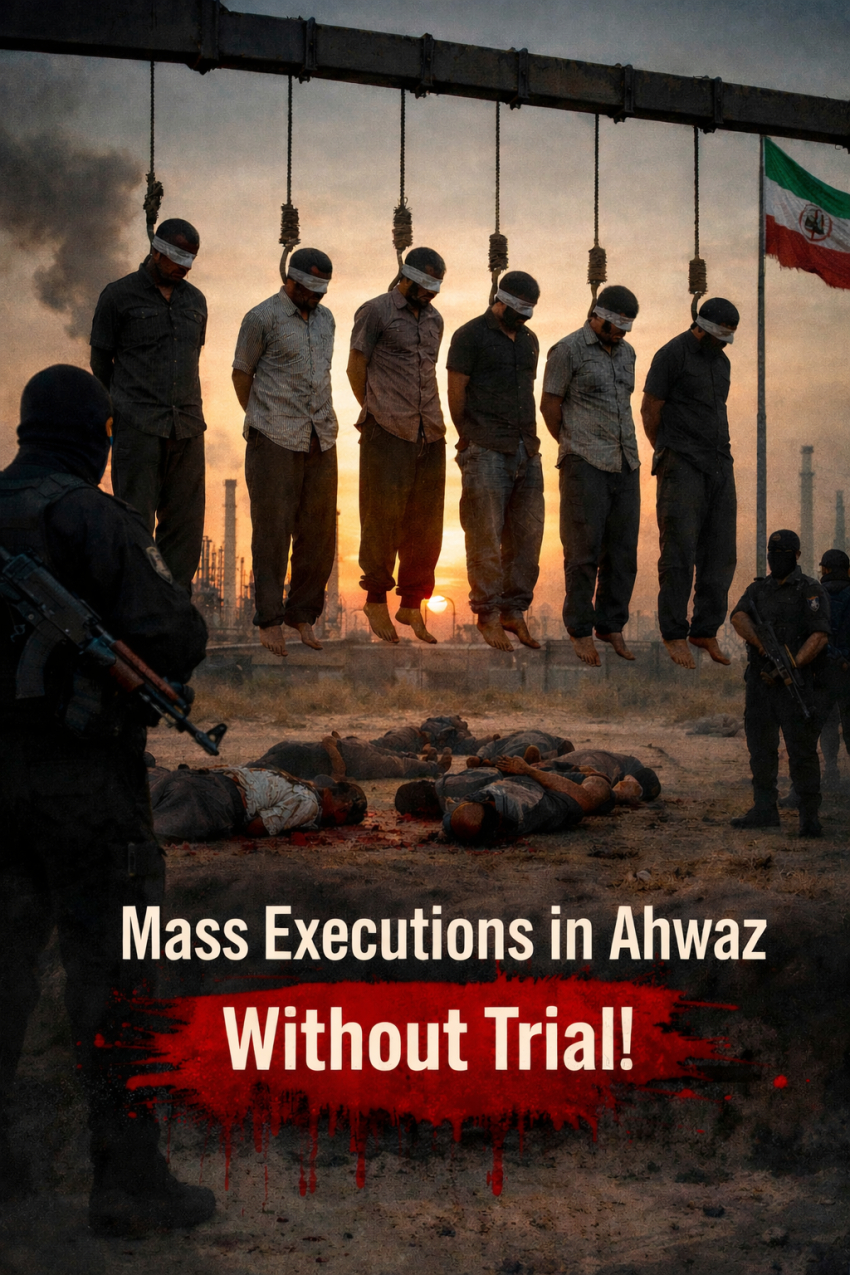



Iran: Stop the Execution of Ahwazi Arab political prisoners
AMNESTY INTERNATIONAL
JOINT PUBLIC STATEMENT
24 January 2013
AI Index: MDE 13/007/2013
Iran: Stop the Execution of Ahwazi Arab political prisoners
Whereabouts of Five Condemned Men Unknown
Iran’s judiciary should quash death sentences against five members of Iran’s Ahwazi Arab minority and
immediately cancel their execution, Amnesty International and Human Rights Watch said today. The
sentences were handed down by a revolutionary court and upheld by the country’s Supreme Court on 9January 2013.
The five men – Mohammad Ali Amouri, Sayed Jaber Alboshoka and his brother Sayed Mokhtar
Alboshoka, Hashem Sha’bani Amouri, and Hadi Rashidi (or Rashedi) – are all activists in Iran’s Arab-
majority Khuzestan province, in southwest Iran. A branch of the Revolutionary Court sentenced them to death on terrorism-related charges following an unfair trial in July 2012. On 18 January, authorities
informed families gathered outside Karoun Prison in the south-western city of Ahvaz that the five men
had been transferred out of the prison. Their whereabouts are unknown.
“The reported transfer of these men to an unknown place is an extremely worrying development,” said
Ann Harrison, Deputy Middle East and North Africa Director at Amnesty International. “In Iran, death
row prisoners are generally moved to solitary confinement before their death sentences are carried out,and we fear that the authorities may be planning to execute them imminently.”
Security forces arrested all five men at their homes in early 2011 in advance of the sixth anniversary of
widespread protests by Ahwazi Arabs in April 2005. Authorities arrested Mohammad Ali Amouri 20
days after Iraqi authorities had forcibly returned him to Iran, from which he had fled in December
2007. They did not allow him family visits for the first nine months. The human rights groups have
received information that Amouri was subjected to physical and psychological torture during this time.
Rashidi was hospitalized after his arrest, possibly as a result of torture or other ill-treatment. Sources
have told the groups that he is in poor health.
Family members outside the country have said that Sayed Jaber Alboshoka’s jaw and teeth were broken
during his detention and that Sayed Mokhtar Alboshoka has experienced depression and memory loss
as a result of torture or other ill-treatment.
In May 2012, Al Arabiya reported that Intelligence Ministry agents forced Sha’bani to confess to
crimes he had not committed by pouring boiling water on him.
A branch of the Revolutionary Court convicted the men in July 2012 on vaguely worded charges related to national security that did not amount to internationally recognizable criminal offences. These
included “gathering and colluding against state security,” “spreading propaganda against the system,”
“enmity against God,” or moharebeh; and “corruption on earth,” or ifsad fil-arz. The death penalty is a
possible punishment for the latter two. Under articles 186 and 190-91 of Iran’s Penal Code, anyone
found responsible for taking up arms against the state, or belonging to an organization taking up arms
against the government, may be considered guilty of “enmity against God” and risks being sentenced
to death. The specific acts of which the men were accused are not known.
The five men are founding members of Al-Hiwar (“Dialogue” in Arabic), a scientific and cultural
institute registered during the administration of Iran’s former President Mohammad Khatami, who
served from1997 to 2005. Al-Hiwar organizes seminars, educational and art classes, and poetry
recitals that have taken place in the town of Ramshir (known in Arabic as Khalafiye). Authorities
banned al-Hiwar in May 2005, and many of its members have since been arrested.
Iranian Ahwazi Arab rights groups maintain that authorities extracted “confessions” from the five men
while subjecting them to torture or mistreatment and denying them access to a lawyer and their
families for the first nine months of their detention at a local Intelligence Ministry facility. The men
later denied the charges against them in court, sources reported.
Article 38 of the Iranian Constitution prohibits all forms of torture “for the purpose of obtaining
confessions.” The Penal Code also provides for the punishment of officials who torture citizens to
obtain confessions. Despite these legal and constitutional guarantees regarding confessions under
duress, “confessions” are sometimes broadcast on television even before a trial has concluded and are generally accepted as evidence in Iranian courts. Such broadcasts violate Iran’s fair trial obligations under article 14 of the International Covenant on Civil and Political Rights, to which it is a state party.
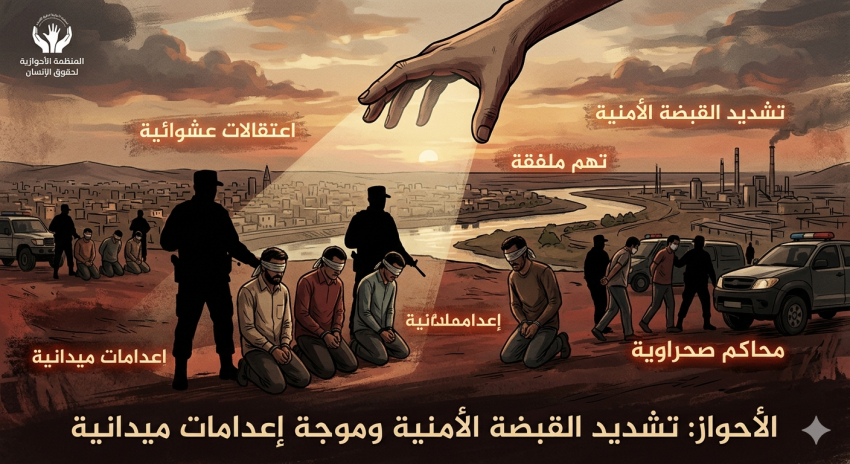
Iranian authorities have executed dozens of people since the disputed 2009 presidential election,
many of them from ethnic minorities, for moharebeh because of their alleged ties to armed or terrorist
groups. Since May 2011, authorities have executed at least 11 Iranian Ahwazi Arab men and a 16-
year-old boy for alleged links to groups involved in attacking security forces.
Rights activists maintain that at least another six Iranian Ahwazi Arabs have been tortured to death in
the custody of security and intelligence forces in connection with anti-government demonstrations that
swept across Khuzestan province on the 2011 and 2012 anniversaries of the 2005 unrest. According
to Kurdish rights activists, more than 20 members of Iran’s Kurdish minority are on death row after
conviction for political offenses. They include Zaniar and Loghman Moradi, who are at imminent risk of
execution.
In 2012 Iran remained one of the world’s foremost executioners, with more than 500 prisoners hanged
either in prisons or in public. Amnesty International and Human Rights Watch oppose capital
punishment in all circumstances because of its irreversible, cruel, and inhumane nature.
“Iranian authorities should end the suffering of the five men’s families by immediately informing them
of their whereabouts and allowing them family visits and access to their lawyers,” said
Eric Goldstein deputy Middle East director at Human Rights Watch. “On no account should they be executed.”
Background
Jaber Alboshoka, 28, is a computer scientist who had been performing his national service as a private in the army; Mokhtar Alboshoka, 28, worked at a stone mining company; Rashidi, 26, holds a masters degree in applied chemistry and was a chemistry teacher; Sha’bani, 39, was an Arabic literature teacher and a student working toward a master’s degree in political science at Ahwaz University; and Amouri, 34, was a fisheries engineer and school teacher.
The Iranian government alleges that the five men are part of an armed Arab terrorist group responsible
for shooting at several government employees. In December 2011 a government-run TV station
broadcast televised “confessions” of several of the men, including Rashidi and Sha’bani, in which they
claimed responsibility for armed attacks against government officials.
Human rights groups have previously expressed concern regarding the condition of Rashidi, Sha’bani, and other Iranian Ahwazi Arab activists detained by security and intelligence forces, and worry about their fate in light of reports of the execution of Heidarian and three other Ahwazi Arab men in June for their alleged role in the killing of a police officer. On 9 June 2012, officials in Ahvaz’s Karoun prison transferred Taha, Abbas, and Abdul-Rahman Heidarian, all brothers, as well as another man, to an unknown location. About a week later authorities informed the men’s families that they had beenexecuted.
The December 2011 programme that aired the confessions of Rashidi and Sha’bani also showed Taha Heidarian “confessing” to involvement in the killing of a law enforcement official in April 2011 amid widespread protests in Khuzestan.
Several days after reports surfaced regarding the executions, Iranian Ahwazi Arab rights groups
circulated a video purporting to show the men, following their arrest by security forces, reading a plea
to save their lives addressed to Dr. Ahmed Shaheed, the United Nations Special Rapporteur on the
human rights situation in Iran. It has not been possible to verify the authenticity of the video.
UN human rights mechanisms have condemned the executions of the four men